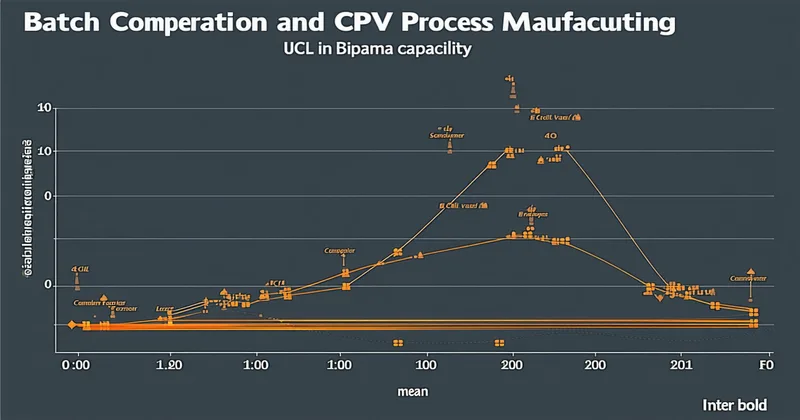
CPV Is Not a Report — It Is a Monitoring Program
FDA's Process Validation Guidance (2011) established a three-stage validation lifecycle where Stage 3 — Continued Process Verification — requires ongoing assurance that the process remains in a state of control during routine production. The regulatory expectation is not a one-time validation package; it is a systematic batch data review that continues as long as the product is manufactured. ICH Q10 reinforces this by framing CPV as a core element of the pharmaceutical quality system, not a post-approval formality.
In practice, many biologics manufacturing sites implement CPV as a periodic summary report — a quarterly or annual document that tabulates CQA results, flags batches that fell outside action limits, and closes with a statement that the process remains validated. That document satisfies the documentation requirement. It does not necessarily satisfy the monitoring intent.
The monitoring intent of CPV is to detect process drift before it becomes a deviation event. A CPV program that only captures metric exceedances cannot detect a slow directional trend in a parameter that has not yet exceeded its alert limit. A genuine CPV program generates batch comparison views that reveal pattern, not just compliance state.
What a Batch Comparison View Should Show
A meaningful batch comparison view for a mAb fed-batch process will display, at minimum, the following across a rolling population of 20–30 consecutive batches:
- Titer (g/L final harvest) with process mean, ±2σ limits, and any action limits defined in the process control strategy
- VCD at each major sampling time point (e.g., day 3, day 7, day 10, final harvest)
- pH mean and range during the production phase, broken out by early (hours 0–48), mid (hours 48–120), and late (hours 120–end) windows
- DO% mean and minimum value per batch, flagged against the 30% minimum specification
- Lactate peak concentration and timing relative to the growth curve inflection point
- Base consumption volume (mL total) as a metabolic integration proxy
These parameters together tell a story about batch-to-batch metabolic consistency. A titer trend that is flat while VCD at day 7 shows a subtle upward drift over the last 8 batches is a signal worth investigating before titer starts to drift — because the culture is running harder to achieve the same yield, which typically indicates media lot-to-lot variability or a seed train quality shift.
Scenario: Reading the Signal Before the Alert
Consider a 2,000L commercial mAb program running on a platform process. The CPV program has titer alert limits set at ±15% of the validated mean. The last 30-batch trending view shows titer within limits — no excursions. But the batch comparison view shows that average day-7 VCD has trended upward by approximately 18% over the last 12 batches, and average lactate peak has increased from 2.8 g/L to 4.1 g/L over the same period. Both parameters are within their individual action limits. Neither has triggered a deviation.
The combination is informative in a way neither parameter is individually: rising VCD with rising lactate peak suggests increasing glucose consumption rate, which is often associated with a media lot shift (different glucose concentration or a different impurity profile affecting metabolic efficiency) or a change in inoculum expansion conditions that increased the starting specific growth rate. Left unaddressed, this pattern typically resolves one of two ways — titer improvement as the culture becomes more productive, or titer decline as the elevated lactate begins to inhibit culture growth in the later phase. It is a branch point, not a safe plateau.
A CPV program that only flags excursions would not surface this pattern. A CPV program built around batch comparison views — using SPC rules such as the Western Electric Rule 4 (fourteen consecutive points alternating up and down) or Nelson Rule 3 (six consecutive points trending in one direction) — would flag the VCD trend at batch 9 or 10 rather than waiting for a titer excursion at batch 15 or 18. The batch comparison engine in Fermentile's analytics layer is specifically designed to apply these SPC rules across the full parameter set rather than parameter by parameter.
The Blind Spots in Standard CPV Designs
We are not saying that a well-structured CPV report fails to meet regulatory requirements — most do meet those requirements. The point is that regulatory compliance is a lower bar than the monitoring sensitivity needed to support genuine process understanding. Four blind spots appear frequently:
Time-series compression
Reducing a 14-day fed-batch run to a single batch-level titer value loses all the within-batch dynamics that predict future performance. The pH control profile in hours 48–96 often carries more predictive signal for titer than the final pH value does. CPV programs that only track batch-level summary statistics cannot see this.
Multivariate co-movement
Univariate SPC on titer, VCD, and pH each individually does not detect correlated co-movement patterns. PCA or MVDA applied to the full parameter vector can detect a shift in process state before any individual variable exceeds its control limits. Most site CPV programs do not include multivariate monitoring because the toolset requires statistical expertise that is not always available in the MSAT team. This is a real operational constraint, not a capability criticism.
Raw material lot confounding
Batch comparison views that do not stratify by media lot or bioreactor vessel cannot distinguish a process drift from a raw material quality event. A glucose lot change that shifts the osmolality by 20 mOsm/kg will produce a signature in the batch comparison view that looks like process drift unless the raw material lot change is overlaid as a categorical variable.
Scale and vessel confounding
For programs running across multiple bioreactor vessels at the same scale, batch comparison without vessel stratification can mask a vessel-specific effect. A single vessel with a partially degraded agitator seal will introduce a systematic bias in that vessel's DO% distribution. Averaged across all vessels, the signal disappears. Stratified by vessel, it is clear.
Structuring the CPV Program for Detection, Not Documentation
The practical restructuring of a CPV program for detection rather than documentation involves three changes.
First, move from batch-aggregate metrics to phase-resolved metrics. Instead of titer per batch, track titer trajectory (titer at day 7, day 10, day 12, day 14) per batch. The within-batch profile is more sensitive to process changes than the endpoint value because it reveals when in the batch a divergence occurred.
Second, implement trend rules rather than limit rules as the primary alert mechanism. SPC trend rules fire before limit rules — they detect drift while it is still recoverable rather than after it has produced an out-of-specification result. The threshold for investigation should be a confirmed trend, not a limit breach.
Third, link CPV outputs explicitly to the change control system. When the batch comparison view shows a sustained shift following a raw material lot change or a maintenance event on a bioreactor vessel, that shift should trigger a change impact assessment, not just a notation in the CPV report. The CPV program is only useful as a process improvement tool if its outputs drive operational decisions. For CDMOs managing multiple client programs, this connection between batch comparison outputs and change control documentation is particularly important because lot-to-lot variability in client-supplied materials is a structural risk that the CDMO cannot fully control.
The Fermentile platform structures the CPV workflow around this three-part approach, with phase-resolved batch comparison views, configurable SPC rule sets per parameter, and a deviation linkage that connects CPV alerts to the deviation management workflow rather than treating CPV as a standalone reporting exercise. For programs where the deviation investigation record connects directly to the CPV trending database, the time from alert to investigation initiation shortens considerably — a structural benefit for programs with aggressive lot release timelines.